
Defining Proscription
Cassius Dio and a wall painting from Pompeii

Proscription was a system of political and state-sponsored violence invented by the Roman dictator Sulla in 82 B.C. Death lists were posted in the Forum at Rome, and it was announced that those named on the lists could be killed with impunity, even by their sons, brothers, or slaves. Anyone who killed one of the proscribed was promised a monetary reward, along with freedom for slaves, and it was forbidden for anyone to help the proscribed. In addition, the property of the proscribed was confiscated by the state and sold at public auction, and punitive measures were imposed on the sons and grandsons of the proscribed.
The term proscription is a euphemism. The Latin proscribere means ‘to write up’ or ‘to publish’, and before Sulla proscriptio was a neutral term for any ‘list’ or ‘public notice’. After Sulla it came to mean ‘death list’, and in modern usage it has become a synonym for ‘prohibition’. For a slightly longer definition, not all behind a paywall, see my entry on proscription in the Encyclopedia of Ancient History.
Ancient writers describe what led to the publication of the first proscription lists, and what happened afterwards.
A key question was scale. At first there were three lists of 80, 220, and 220 names, but more names were added to this initial 520. Some estimate a final total of around 2,000. One source claimed 4,700.
The main sources for Sulla are Plutarch’s Life of Sulla and Appian’s Civil Wars, but both are brief on the proscriptions. The longest account is given by Cassius Dio. It ignores some of the standard questions. It does not speculate on the total body count nor does it give the names of the proscribed. Instead it focus on the psychological impact of the proscription lists.
What was it like to be in Rome, in the Forum, and to read proscription lists? What to do if one found one’s own name on the lists? What to do if one of the proscribed asked for help?
The full text of Cassius Dio’s narrative can be read here; scroll down to fragment 109. Below a few highlights:
No-one knew at first what the lists were. They looked like any other notice set up by Roman officialdom. Such as lists of military recruitment or membership of the Senate.
So passers-by crowded around to read them. Expecting it was an announcement of something positive.
Instead, people read the names of their relatives, or their own. And they were killed on the spot if by their reaction to reading the lists it was obvious that they were proscribed.
Dio then tells us that no-one was safe, and that everyone reading the lists was at risk of being killed:
If one read the list or asked a question, or if one didn’t.
If one laughed or cried, smiled or frowned, if one mourned a friend or took pleasure in the fate of a personal enemy, everyone was being watched, and any reaction could be fatal.
And some were killed because they were mistaken for someone with a different name.
The last point raises an fundamental question: how easy was it for bounty hunters to identify their victims? And does that mean the proscribed, if they were anonymous to strangers, were most at risk from those who knew them?
Dio next turns his attention from the the lists in the Forum to the varied fates of the proscribed.
Some were killed before knowing they were proscribed
Others were killed wherever they happened to be found, and there was no asylum even in temples
Some were spared the fear of death, if they were killed before knowing that they had been proscribed, or at the moment at which they discovered their fate
Others hid in terror, afraid to flee in case they were caught, and frightened of betrayal if they stayed put. And many, we are told, were betrayed by friends and family.
In a postscript, we are told that the heads of the proscribed were put on public display in the Forum, on the Rostra or Speaker’s Platform, and that this led to a repeat of what happened when the lists were first posted. In short, mutual suspicion and fear among the onlookers.
Red Letters on a White Board
Cassius Dio gives us an evocative narrative of the psychology of the crowd and fear of the proscribed. He sets the scene as the Forum in Rome: first the lists, then the heads, side-by-side on the Rostra.
One detail adds to how we imagine the scene. The proscription list, we are told, was a ‘white board’ or ‘whitened tablet’. In Greek, τὰ λευκώματα or λελευκωμένος πίναξ. This was an ephemeral piece of writing in which the text was painted in red letters on a white background for visibility.
Death came in red letters on a white board.
It was normal practice for Roman notices or signs to be written in red letters on a white background, and if we are looking for illustrations, we can look to Pompeii to the notices and adverts that were painted on the whitewashed walls by professional sign writers.
One example below is an election poster in which Zmyrina and her coworkers at Asellina’s bar endorse one of the candidates for the office of duumvir, the top annual magistracy in the town:
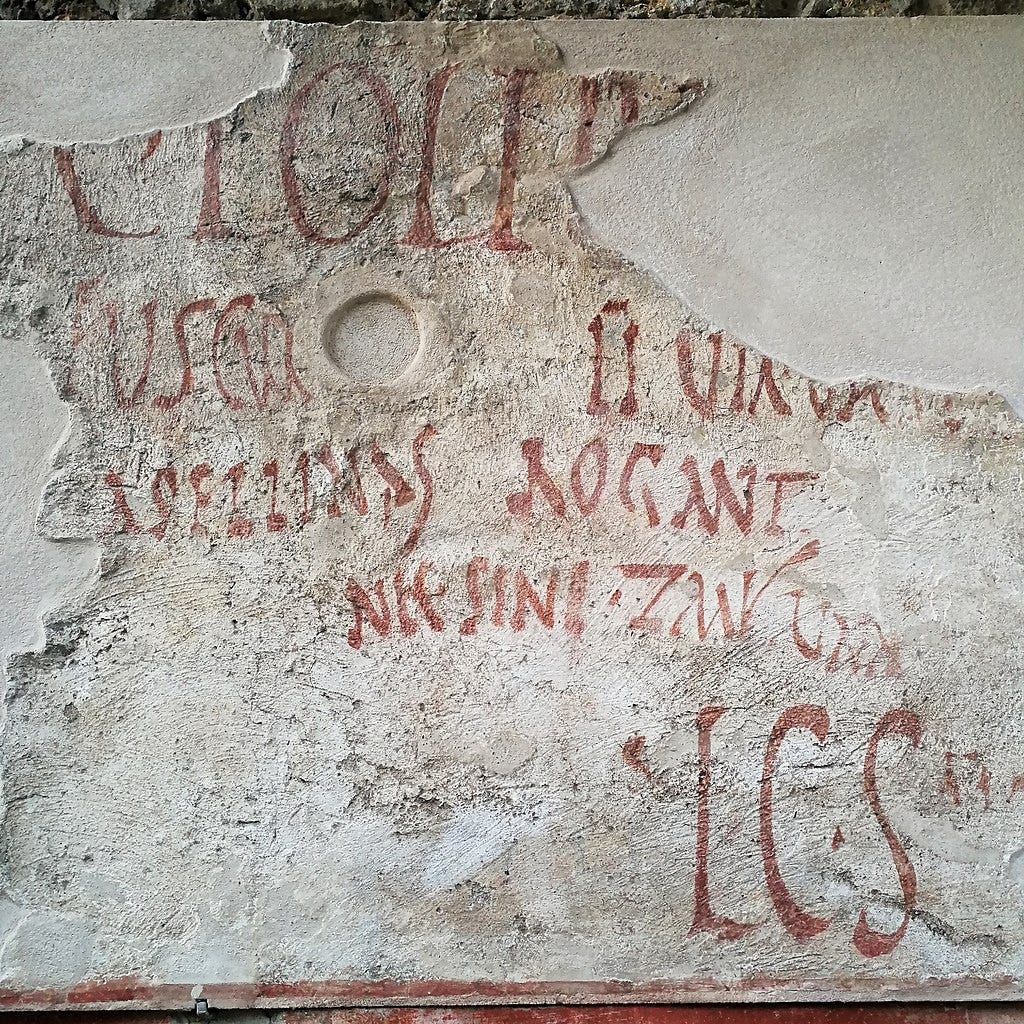
Image: Marco Ebreo 2018 Wikimedia Creative Commons

Or, if one thinks of the proscription lists as a long list of densely-packed names, one may think of the red-lettered inscriptions in the Capitoline Museum at Rome with the names of consuls. Or the Fasti Triumphales, below, a list of those who were awarded a triumph:
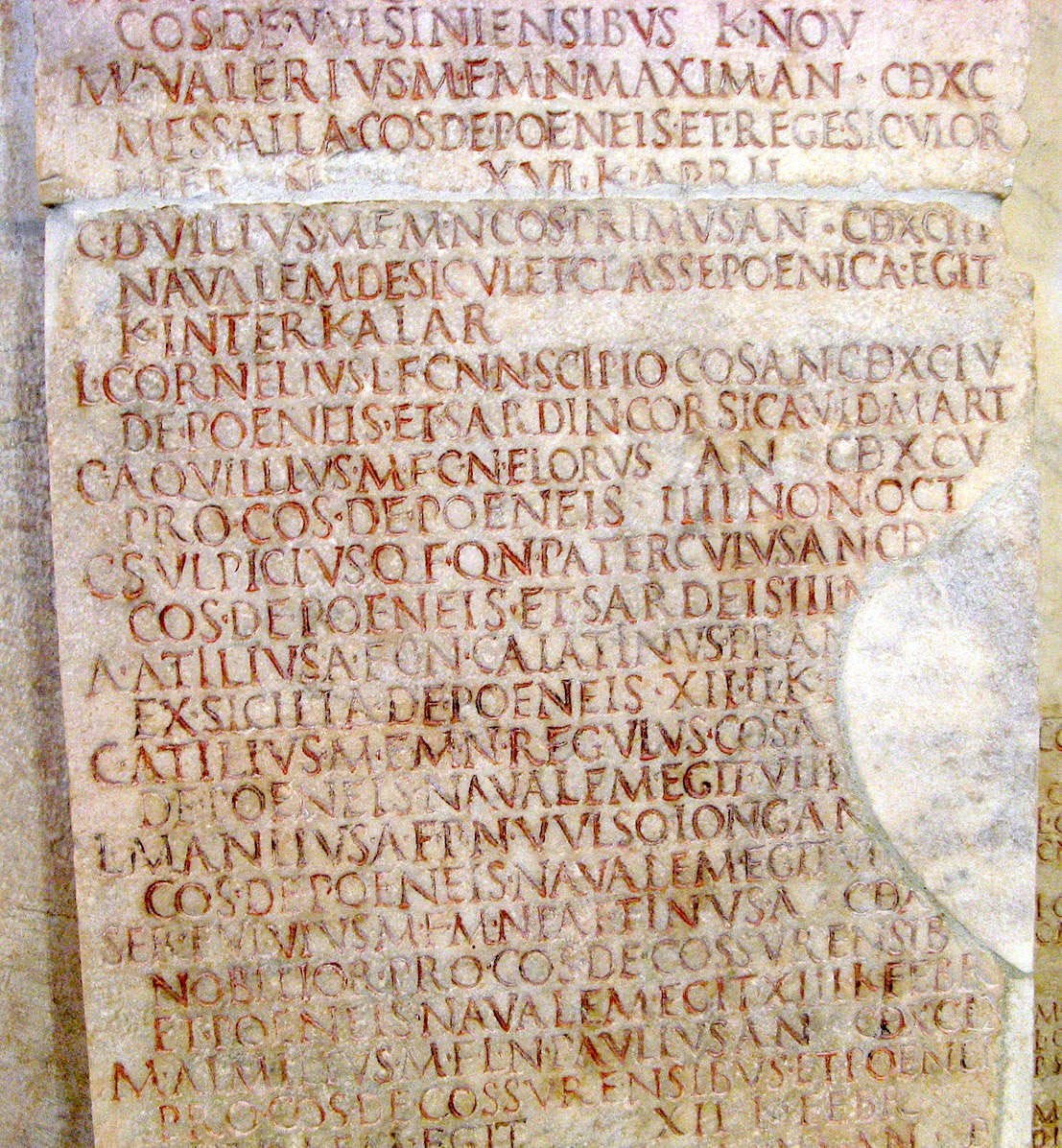
Image: Rossignol Benoît 2011 Wikimedia Creative Commons
p47fgtXXFastitriumphales.jpg)
Normal red-letter lists like the consular or triumphal fasti show men at the pinnacle of an elite career. The red-letter proscription list gave the names of elite men whose lives and careers were being destroyed.
The first four names on the list, we happen to know, were the anti-Sullan consuls of 83 and 82 B.C.
Reading the Lists
Cassius Dio’s narrative captures the moment at which onlookers read the proscription lists with no awareness of what they were going to read. A normal day in the Forum, and a sudden change with the realisation that what they were reading was a death list, something no-one had ever seen or imagined before.
The moment after the realisation has been chosen by illustrators, and one example is an engraving by Silvestre David Mirys (1750-1810) in a collection of illustrations of Roman history.
The list starts, correctly, with the names of the consuls of 82, then the consuls of 83. And the caption alludes to an episode described by Plutarch: a certain Aurelius who kept out of politics was the victim of a fraudulent proscription, targeted for his wealth, and his reaction to reading his own name on the list was to state that he had been proscribed by his country villa outside Rome.
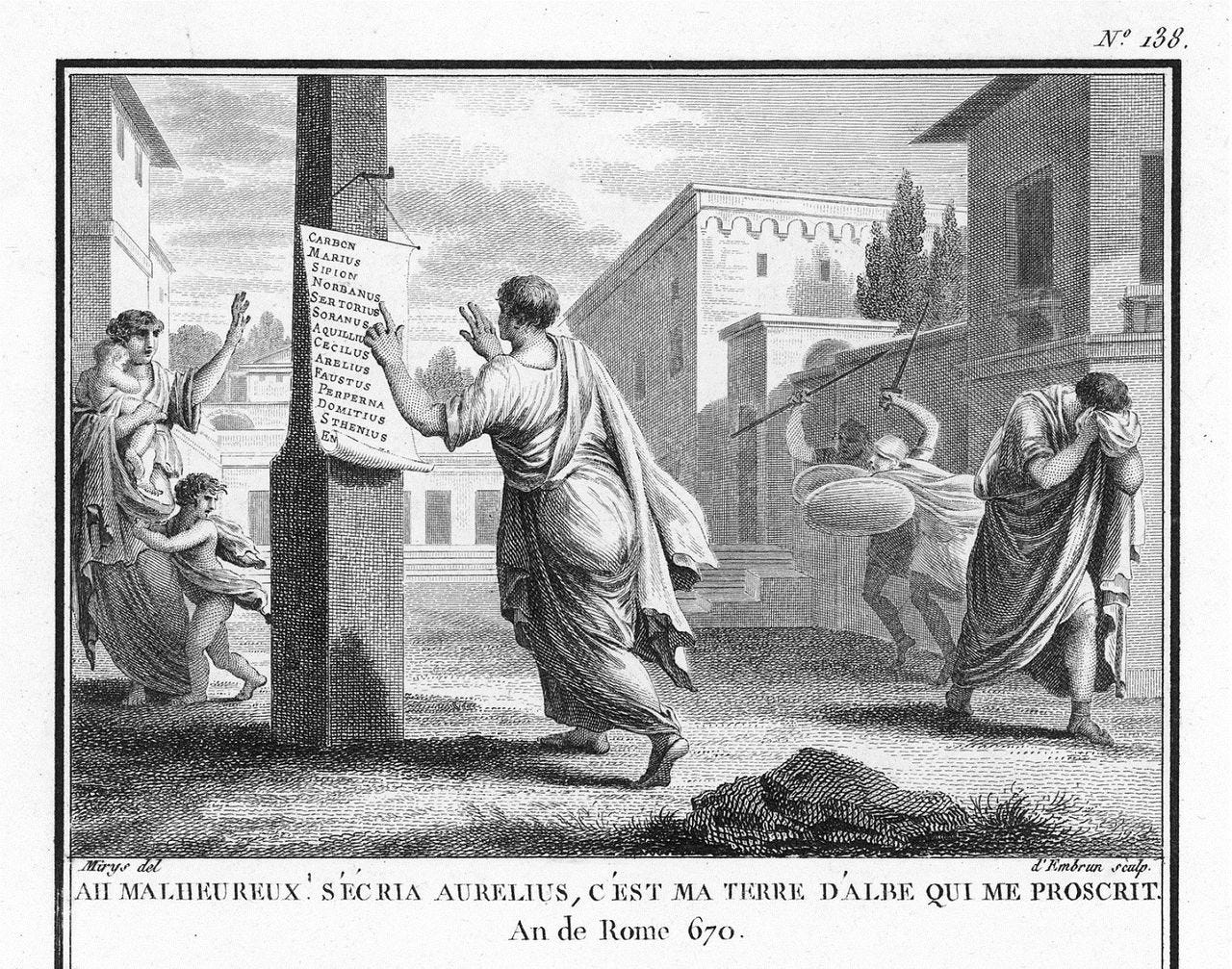
Image: Silvestre David Mirys, c. 1799; public domain, Wikimedia Commons

It is not the best illustration of the moment of proscription: there are only a dozen names on the list, the figure of Aurelius is pointing at someone else’s name, and the Forum is empty of people.
The image below is more evocative. It is called Le tavole di proscrizione, i.e. the lists of proscription, and it is a lithograph by Alberto Gilli (1840-1894) copying a painting by Giuseppe Boschetto (1841-1918).
There is a crowd, with soldiers. One main points at the list in agitation. Another man, dressed in dark clothes, walks away with his head covered. This is drawn from anecdotes in the sources: an individual who read his own name on the list and tried to hide his identity, but he was spotted by someone in the crowd and killed.
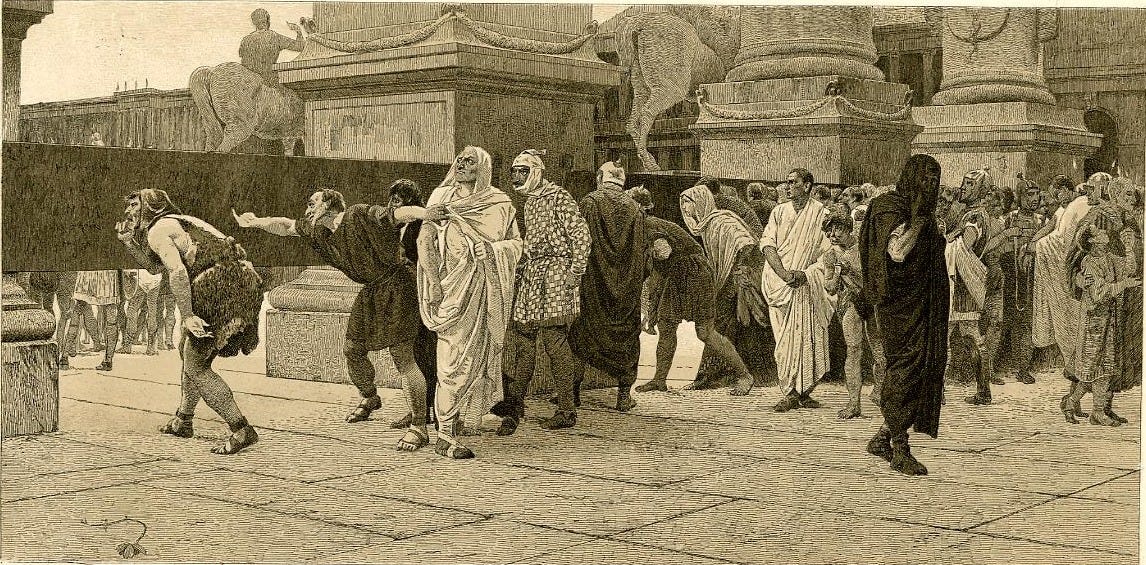
© The Trustees of the British Museum. Shared under a Creative Commons Attribution-NonCommercial-ShareAlike 4.0 International (CC BY-NC-SA 4.0) licence
In the above image the proscription lists are suitably long, and they are posted fixed to a series of column bases.
The detail of having lists fixed to columns is authentic, and it brings us to an image that for me gives the best illustration of the proscriptions.
It is a wall painting from Pompeii and it shows a everyday scene in the Forum. There is a colonnade, a series of equestrian statues, and a crowd reading a long public notice fixed to the bases of the statues.
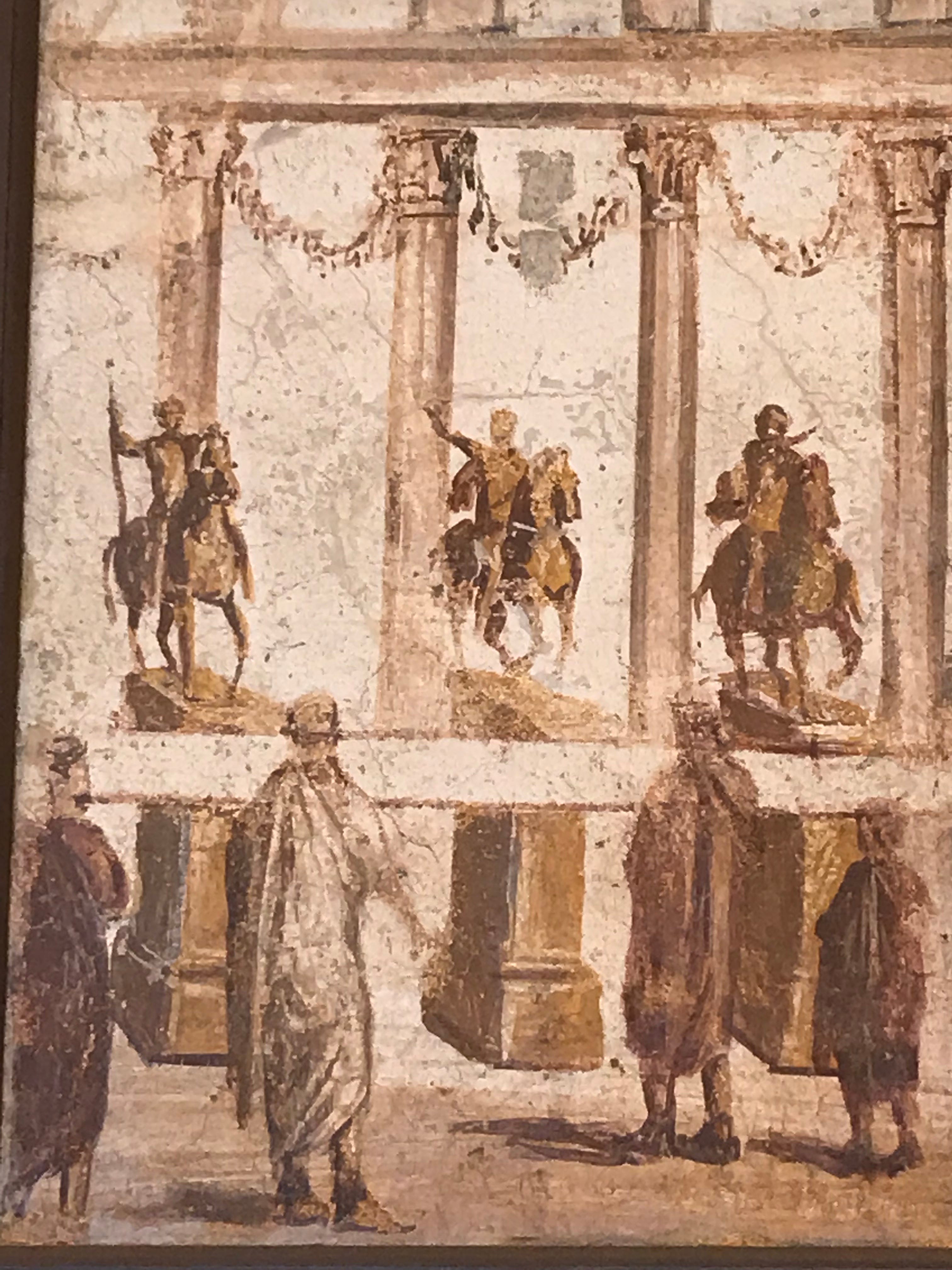
Photo: the author. Image: Naples Archaeological Museum Inv. 9068, from the estate of Julia Felix (Pompeii II.4.3)
This is how we can imagine the Forum crowds in Sulla’s Rome.
Reading the proscription lists before the moment of realisation, described by Cassius Dio, when it becomes clear to them what they are reading.
Rome’s first death lists.
Tell me which of the above images you think best illustrates the proscriptions, and share links to other images you think I should know about.